What Is Ocean Acidification? The Other Carbon Problem Changing the Seas
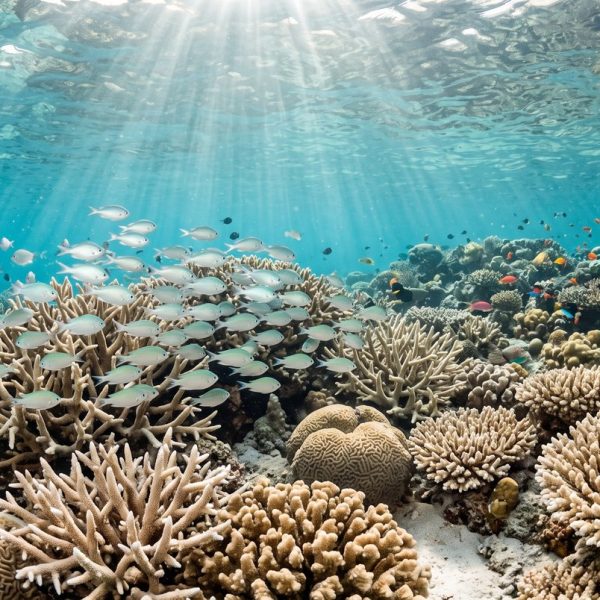
Most conversations about carbon dioxide focus on the air. But roughly a quarter of the CO2 we release never stays in the atmosphere at all. It dissolves into the sea, and once it does, it begins to change the chemistry of the water itself. That slow shift is called ocean acidification, and while it draws far less attention than heatwaves or melting ice, it may be one of the most consequential changes happening to the planet right now.
The name sounds dramatic, and it can mislead. The ocean is not turning into acid. What is happening is subtler and, in some ways, more worrying, because it reaches the very base of the marine food web.
What ocean acidification actually is
Seawater is naturally slightly alkaline. When carbon dioxide dissolves into it, the gas reacts with water to form carbonic acid, which lowers the water's pH and reduces the amount of carbonate available. Carbonate is the raw material that corals, oysters, mussels, and countless tiny plankton use to build their shells and skeletons. Take it away, and building those structures becomes harder and far more energy intensive.
Since the start of the industrial era, the surface ocean has grown about 30 percent more acidic. That figure comes from steady measurements at monitoring stations around the world, and the trend closely tracks the rise in atmospheric CO2. Researchers have documented the mechanism in detail, and the reference page maintained by Wikipedia on ocean acidification lays out the chemistry clearly for anyone who wants the full picture.
The effects of ocean acidification on marine life
The clearest ocean acidification effects show up in animals that depend on calcium carbonate. Oyster hatcheries on the Pacific coast of the United States were among the first to notice, when corrosive water started killing larvae before they could form shells. Since then, scientists have watched the same pressure ripple outward.
Pteropods, the small sea snails sometimes called sea butterflies, are a good example of how ocean acidification affects marine life at the bottom of the chain. Their thin shells begin to dissolve in more acidic water, and because they feed fish, seabirds, and whales, trouble for them means trouble for everything that eats them. When the base of a food web weakens, the effect is rarely contained.
Why coral reefs feel it first
Coral reefs sit right in the firing line. Corals build their stony foundations from carbonate, so a more acidic ocean slows their growth and leaves existing structures more brittle. Combined with warming water, which drives bleaching, acidification makes it harder for reefs to recover between stress events. That matters far beyond the reef itself, since these habitats shelter roughly a quarter of all marine species and protect coastlines from storms.
Plastic and chemical pollution pile on further, and a closer look at how pollution affects marine ecosystems shows just how many stresses these habitats absorb at once. Acidification rarely acts alone.
Ocean acidification is a good example of a problem that never produces a dramatic photograph, which is partly why it stays underfunded. Textile pollution has the opposite problem, generating vivid imagery while the underlying question of what is sustainable fashion stays deliberately vague. Visibility and importance are only loosely related.
What it means for people
This is not only an environmental story. Billions of people rely on the sea for protein, and shellfish farming alone supports large coastal economies. As acidification and warming reshape where fish can live and how well shellfish grow, the effects reach markets, jobs, and food security. Because the ocean does not respect borders, the research and the response are inherently international. Scientists in dozens of countries pool their data, and turning that shared knowledge into policy often depends on careful translation of technical documents across languages so that findings are not lost between institutions.
Lake ecosystems respond to industrial history for generations after the industry itself has gone. Water quality is a long-term ledger. The recovery of the lakefront is central to how cleveland ohio has repositioned itself, and it took decades rather than years.
Solutions to ocean acidification
The honest answer on solutions to ocean acidification is that there is one root cause and therefore one primary fix: cutting carbon dioxide emissions. Because the sea keeps absorbing atmospheric CO2, lowering emissions is the only measure that addresses the problem at its source rather than treating symptoms.
Local action still helps. Protecting seagrass meadows and kelp forests, which absorb carbon and can buffer nearby water, gives sensitive species a little breathing room. Cutting runoff and nutrient pollution eases the combined burden on reefs and shellfish beds. And expanded monitoring, like the networks tracked by NOAA, helps hatcheries and fisheries adapt by warning them when corrosive water is on the way. None of these replace emissions cuts, but they buy time.
How scientists actually measure it
Tracking ocean acidification means going to sea again and again. Research buoys and repeat survey cruises sample the same patches of water for decades, measuring pH, dissolved carbon, and carbonate saturation. Long records like the ones from Hawaii and Bermuda are what let scientists say with confidence that the change is real, steady, and tied to the carbon we put into the air rather than to natural swings.
A slow change worth watching
Ocean acidification is easy to overlook precisely because it is invisible and gradual. There is no single dramatic image, no smoke and no flame. Yet it is measurable, it is speeding up, and it is already affecting industries and ecosystems today. Understanding it is the first step toward taking it seriously, and the sea, quietly absorbing our carbon year after year, has been keeping the receipts all along.